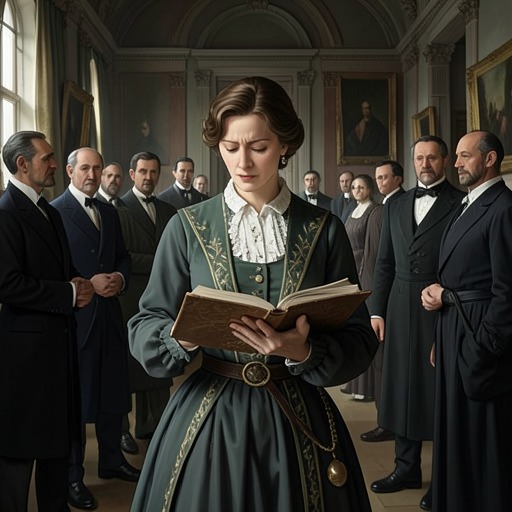
Hyacinth Robinson
The Parallax ViewHyacinth Robinson is the revolutionary figure at the center of The Princess Casamassima’s political deadlock. He sees with unusual clarity the opposing claims of the dispossessed and of high culture, but cannot reconcile them or choose between them. His refusal to destroy an upper-class figure is not presented as a solution to the conflict: in the book’s closing interpretation, it exposes his inability to create an alternative. His suicide becomes the sole action through which that impasse can be expressed, a destructive ending that also functions as a symbolic statement.
Identity and Political Setting
Hyacinth belongs to a group of low-class revolutionary characters through whom the novel approaches anarchist politics in the London slums of the 1880s. The novel presents these figures sympathetically, in contrast to upper-class characters portrayed as vain and vulgar. Its attention to the poor is compassionate, especially in its impressions of their suffering, but it does not provide a portrait of the revolutionary movement as a collective force. It can render individual revolutionary types—Poupin, Schinkel, and Muniment—with distinction; it cannot make their separate qualities add up to a convincing account of radicalism as a whole.
That gap matters for Hyacinth’s place in the novel. He is not simply a representative who makes revolutionary politics legible. His predicament helps reveal what remains unresolved when the rights of the poor and the claims of cultural inheritance are set against one another. The book does not endorse the idea that the suffering of the anonymous poor can be justified by preserving monuments of culture or the refined life of the upper classes. Those who stand for that inheritance are themselves compromised: their gestures of cultivation conceal vulgarity, and their rituals are empty. Yet exposing that hypocrisy does not make the conflict disappear. Hyacinth faces claims that cannot be reduced to a comfortable choice between a corrupt ruling class and an uncomplicated revolutionary answer.
The Deadlock Between Two Claims
The novel’s decisive problem is an antinomy: how to recognize the rights of the dispossessed without treating high culture as worthless, and how to value that culture without accepting the suffering on which its preservation has been paid for. Hyacinth’s distinction is also his burden. He can see each side of the question too well to make the choice appear innocent. His perception therefore does not lead to a stable position or a practical resolution; it leaves him caught between incompatible demands.
This impasse is described through the image of parallax: two perspectives disclose different sides of a shared situation, but no common standpoint reconciles them. Hyacinth’s tragedy is not merely that he encounters opposing social forces. It is that he can register the force of both perspectives while lacking a way to join them in action. The conflict is consequently not solved by declaring one side right and the other false. His suicide marks the cost of remaining suspended between the rights of the poor and high culture when neither can be made to vanish from view.
Refusal, Destruction, and Creation
Hyacinth does not carry out the act of murdering an upper-class figure. That refusal might seem to offer a moral escape from revolutionary violence, but the interpretation of his character treats it more harshly: refusal to destroy is also an inability to create. His failure is not praised as a complete alternative to violence, because nothing new emerges from his restraint. The withheld destructive act leaves the deeper conflict intact and reveals the absence of a creative response to it.
The contrast with James clarifies the point. James, too, is described as withdrawing from participation in life and confronting an inability to act, but he can work through that withdrawal by turning it into writing. Hyacinth cannot make the same transformation. Where artistic work can give form to an impasse, Hyacinth’s remaining refusal does not become a new creation; his final self-destruction is the only work of art available to him. The comparison makes his ending more than a personal defeat: it distinguishes a withdrawal that can be made productive through art from one that closes upon itself.
Ending and Narrative Significance
Hyacinth’s suicide concludes the novel by giving the deadlock a final, symbolic form rather than resolving it. His ending does not vindicate a resigned conservatism, since the upper-class figures associated with cultural inheritance are shown as false and compromised. Nor does it offer a triumph for revolutionary politics, since the novel cannot portray the movement as a collective whole and Hyacinth cannot convert his perception into a transformative act. The ending holds both failures in view: the poor remain wronged, while the cultural inheritance cannot simply be accepted as innocent.
The interpretation also reads Hyacinth’s irresolution through sexual difference. His deadlock is explicitly distinguished from a supposed feminine passivity: it signals his inability to perform what the argument calls a properly feminine act, a negative gesture that could cut through the impasse. The comparison is to Isabel Archer at the end of The Portrait of a Lady, whose ending supplies a model for that kind of gesture, though Hyacinth does not achieve it. This comparison sharpens the account of his limitation: seeing both sides is not itself an act capable of breaking their hold. Hyacinth remains the figure through whom the novel makes its antinomy visible, and his suicide leaves that conflict exposed rather than reconciled.